
India appears poised to sustain its growth in a more durable way than before with the economy carrying the momentum from FY23 into the current fiscal year, the Annual Economic Review for 2022-23 released by the finance ministry on Thursday said. However, the report cautioned that escalation of geopolitical stress, enhanced volatility in global financial systems, sharp price correction in global stock markets, a high magnitude of El-Nino impact, and modest trade activity and FDI inflows, are factors that could constrain the pace of growth. "Should these developments deepen and dampen growth in the subsequent quarters, the external sector may challenge India's growth outlook for FY24," the finance ministry said.

India's electric two-wheeler (E2W) sector is expected to cross the one million mark in 2024 fuelled by rising demand, increased production, and affordability, industry experts said, even as several original equipment makers are expanding their penetration to rural areas. Improved battery technology and innovative features are also likely to fuel growth, they said. "E2W sales will breach the 1-million mark in 2024 as the demand for electric two-wheelers is expected to continue growing due to factors such as environmental awareness, government incentives, and improvements in technology," Hyder Khan, chief executive officer (CEO), Godawari Electric Motors, said.

286 dealers closed down in 18 months, 32,000 jobs impacted. Maharashtra leads with 84 closures, followed by Tamil Nadu and Delhi. The worst-hit is the passenger car segment.

Qatar Investment Authority (QIA) will acquire around 1 per cent stake in Reliance Retail Ventures Ltd (RRVL), the retail arm of billionaire Mukesh Ambani-led Reliance Industries, by investing Rs 8,278 crore ($1 billion). A QIA's wholly-owned subsidiary will make the investment in India's largest retailer at a valuation of Rs 8.278 lakh crore ($100 billion). Updating about the development, Reliance Industries in a regulatory filing said: "QIA's investment will translate into a minority equity stake of 0.99 per cent in RRVL on a fully-diluted basis." RRVL is the holding company for all retail businesses of Reliance Industries Ltd (RIL).

'It will dictate the flow of funds into the index. We will maintain caution on mid/smallcaps.'

In a dazzling resurgence, foreign investors have graced the Indian equity markets with an influx of nearly Rs 1.5 lakh crore in 2023, fuelled by optimism over the country's resilient economic fundamentals amid shadows of a gloomy global scenario. Experts believe that the positive trend may continue in 2024. This follows Indian equities witnessing the worst-ever net outflow of Rs 1.21 lakh crore by FPIs in 2022 on aggressive rate hikes by the central banks globally after net inflows for three consecutive years.

India's economy grew 6.1 per cent in the fourth quarter of 2022-23, pushing up the annual growth rate to 7.2 per cent, official data showed on Wednesday.

Enthused by higher than expected GDP numbers in the fourth quarter of 2022-23, Chief Economic Adviser (CEA) V Anantha Nageswaran on Wednesday said India's economic growth may exceed the initial estimate of 6.5 per cent in the current fiscal and the country can look for another year of solid economic performance.

Excise duties on mobile phones to be 1% without CENVAT credit or 6% with CENVAT credit. This provision will have marginal impact on telcos.

Mukesh Ambani-led company will squeeze market shares and margins of existing players

Housing sales across top eight cities rose 51 per cent last year, even as the office market continued to slump due to the Covid pandemic with gross leasing witnessing a 3 per cent fall, according to Knight Frank India. Housing sales increased to 232,903 units during last year, from 154,534 units in 2020, but demand was down 5 per cent from the 2019 pre-pandemic levels and 37 per cent lower than the 2011 peak numbers. In the office segment, the gross leasing of office space fell to 38.1 million square feet in 2021, from 39.4 million square feet in the previous year, due to the adverse impact of the second wave of the Covid pandemic.

Notwithstanding expectations of a pick-up in construction activity during a seasonally strong January-March quarter (fourth quarter) of 2022-23 (FY23), analysts are cautiously optimistic about the building material sector - encompassing paints, pipes, wood panels, tiles, metals, and cement - as volatile input costs, coupled with fears of a global slowdown, are making demand projections uncertain. Against this backdrop, analysts suggest investors stay selective and pick stocks of companies with stronger brand recall, expanding distribution network, diversified product profile, healthier balance sheet, and sustainable cash flow. "The government's various proposals under Budget 2023-24 (FY24) may lead to the building material segment growing between 8 per cent and 12 per cent for the next five years.

Titan Company on November 21, became the second Tata group firm to join Rs 3 trillion market capitalisation (market cap) club after its shares hit a new high of Rs 3,400, up nearly 2 per cent on the BSE in Tuesday's intra-day trade. At 12:28 PM; with a market cap of Rs 301,847 crore (Rs 3.02 trillion) Titan stood at number 16th position in overall market cap ranking on the BSE listed companies, the exchange data shows. Titan overtook paint company Asian Paints, which has a market cap of Rs 300,579 crore, data shows.

An improvement in political relations, anchored in a restoration of peace and tranquillity at the border, could open up opportunities for expanded economic and commercial relations between them, suggests former foreign secretary Ambassador Shyam Saran.

Ratings firm Fitch on Wednesday assigned a stable outlook to the Indian auto components sector in 2012 and said it is expected to perform well on the back of demand from original equipment manufacturers for localised content.

The global turmoil in the banking sector has made analysts cautious, who advise that investors stay away from stocks of this sector till the overall sentiment improves. The recent trouble for the banking sector started with the collapse of US-based Silicon Valley Bank (SVB), Silvergate Capital and Signature Bank. On its part, Moody's Investors Service has also cut its outlook for the US banking system to 'negative' from 'stable', citing the run on deposits at these three banks that led to the collapse of these banking majors in less than a week.

Macroeconomic data announcements, global trends and trading activity of foreign investors would guide momentum in the equity market this week, analysts said. Markets ended a five-week losing streak and gained nearly a per cent last week, helped by a sharp rebound on Friday. Last week, the BSE benchmark jumped 500.65 points or 0.77 per cent and the Nifty gained 169.5 points or 0.87 per cent.

Lenders in India, comprising banks and finance companies, anticipate robust growth in retail credit during the upcoming festival season, stretching from September to December 2023. This expectation is based on resilient demand, government initiatives, and elections in key states.

Brokerages believe that the Bharatiya Janata Party's (BJP's) stronger-than-expected showing in state elections reduces political risks for the domestic markets going into 2024. However, after the short-term excitement, the focus will soon shift to earnings, global liquidity conditions, and the interest rate trajectory. "BJP's win in the three state elections is much better than what exit polls suggested and reinforces the consensus expectations of a Modi win in the 2024 national elections with a greater likelihood of 300+ seats for the BJP.

Capital goods companies in their Q2FY24 results are expected to report another steady quarter of earnings growth as order inflows and execution remain healthy, according to analysts. An upward revision in order inflow targets and a margin improvement due to lower raw material costs are also anticipated. "We expect the execution of all capital goods companies and most EPC (engineering, procurement, and construction) companies to remain healthy Y-o-Y (year-on-year), led by strong order book accretion in the past 5-6 quarters," wrote analysts at Kotak Securities in a note, estimating revenue growth of 32 per cent for India's largest company in the capital goods space -- Larsen & Toubro.

The year 2018 is likely to be steady in terms of institutional investment into real estate

Equity benchmark indices Sensex and Nifty buckled under selling pressure after a nine-session rally on Monday, as massive sell-off in IT, tech and telecom counters unnerved investors.

The sales of construction companies are expected to rise in the current quarter and financial year on the back of strong order books and increased activity in infrastructure.

IT sector replaces auto sector after a 6-month gap.

GDP growth of 7.7 per cent in the first half of this fiscal has "left sceptics gasping and woefully behind the curve", an RBI article said on Wednesday. It also stressed the buildup in the growth momentum is likely to be sustained. The article on the state of the economy published in the Reserve Bank's December Bulletin on Wednesday also said CPI-based retail inflation is expected to ease to 4.6 per cent in the first three quarters of 2024-25 from 5.6 per cent in November.

'It will send a very strong signal that it is now our time to grow.'

The recent equity market weakness has sobered up investor mood, but the coming festive season is keeping analysts upbeat on stocks related to the consumption basket. Among the lot, fast-moving consumer goods (FMCG), retail, and consumer electronics segments are expected to do well over the next few months, and investors should thus selectively take bets in these pockets, analysts suggest. "We expect good volume growth for the FMCG sector during the festive season with some improvement in rural demand.

Foreign Portfolio Investors (FPIs) pumped in Rs 43,838 crore in Indian equities in May, the highest level in nine months, supported by strong macroeconomic fundamentals, and reasonable valuations. FPIs continued the buying stance in June too, and invested Rs 6,490 crore in just two trading sessions of the month, data with the repositories showed. VK Vijayakumar, chief investment strategist at Geojit Financial Services, said that inflow by FPIs will continue in the current month since the latest GDP data and high-frequency indicators reflect a robust economy gaining further strength.

The auto component sector grew at 5-6 per cent last year against a 13 per cent growth in 2012.

After a sharp correction over the last few months, analysts seem to be turning cautiously optimistic on the information technology (IT) sector and suggest there could be trading opportunities in select counters despite revenue and growth concerns that still plague the sector. "IT stocks valuations have corrected 17 per cent-49 per cent and stock prices have corrected 9 - 42 per cent since mid-December 2021. Nifty IT index valuation has corrected by 27 per cent and price by 21 per cent. "About two quarters ago, we made a case that valuation drivers have peaked.

Stocks of small- and mid-cap companies continued to gain ground in July, notwithstanding analysts sounding caution on these two market segments given the sharp run thus far in calendar year 2023 (CY23). Sanjeev Prasad, co-head of Kotak Institutional Equities, in a note co-authored with Anindya Bhowmik and Sunita Baldawa in June-end, had cautioned against the sharp run in small- and mid-caps. "We do not see any particular reason for the excitement in small- and mid-cap stocks.

The RBI left interest rates unchanged, saying there was no substantial development on inflation or fiscal fronts to warrant a fresh reduction.

Catamaran, the family office of Infosys founder Narayana Murthy, is targeting 15 per cent returns on its portfolio investments per annum as it shifts focus from early-stage investments to growth and late-stage bets. This would double the firm's assets under management (AUM) from the current $1 billion to $2 billion over the next five years. "For direct investments, we are focusing on growth-stage investments and very selectively on early stage," Deepak Padaki, president, Catamaran, told Business Standard. "(This is) primarily because the early-stage space in India, in the last three-four years, has completely changed. "There has been a huge influx of capital in the last two years. It has become a very crowded space for early-stage investment," he said.

The government has extended excise duty concessions beyond 30th June 2014 for a period of 6 months up to 31st December 2014.

'We are in a sweet spot.' 'Equity, on a standalone basis, will continue to remain the asset class to stay invested in.'

Equity mutual funds (MFs) deployed maximum in shares of Reliance Industries (RIL) in June at Rs 2,177 crore, followed by Maruti Suzuki (Rs 2,045 crore) and Bharti Airtel (Rs 1,310 crore). Shares of both RIL and Bharti Airtel have been turbulent this month. On July 1, shares of RIL crashed over 7 per cent, following the government imposing windfall taxes on domestic crude oil production and fuel exports.

The International Monetary Fund (IMF) on Tuesday cut its projection of India's economic growth in 2022 to 6.8 per cent, as it joins other global agencies that have trimmed forecasts. The IMF had in July projected a gross domestic product (GDP) growth of 7.4 per cent for India in the fiscal year that started in April 2022. Even that forecast was lower than 8.2 per cent projected in January this year. India had grown at 8.7 per cent in 2021-22 fiscal (April 2021 to March 2022).

A healthy growth in India's services segments has helped the country's total exports and imports of goods and services to cross the $800 billion mark during the first half of 2023, despite a slowdown in global demand, think tank GTRI said in a report on Monday. According to the analysis of the Global Trade Research Initiative (GTRI), exports of goods and services rose by 1.5 per cent to $385.4 billion during January-June this year, as against $379.5 billion in January-June 2022. Imports, however, dipped by 5.9 per cent to $415.5 billion during the six months of this year, as against $441.7 billion in January-June 2022.
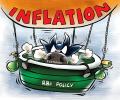
The Reserve Bank on Wednesday projected inflation to come down below the upper threshold level of 6 per cent by March quarter of the current fiscal. RBI Governor Shaktikanta Das said the central bank will keep 'Arjuna's eye' (focus) on the evolving inflation dynamics and will remain 'nimble and flexible' to deal with the price situation. Global commodity prices, including crude oil, have undergone some downward correction, but uncertainty continues to surround the near-term outlook in view of the prolonging geo-political hostilities. Moreover, the resurgence in domestic services sector activity could also lead to price increases, especially as firms pass on input costs.
